
For critical roles where speed, discretion and evidence must work together
AnthroMethod
From search process to decision system:
for faster decisions with more confidence
AnthroMethod is HumanRelevant’s operating model for market-first executive search and critical-role decisions. It combines market visibility, structured, role-specific evaluation, candidate engagement and governance in one auditable workflow.
Its most visible output is Market Map Plus: a dynamic, versioned decision architecture — not a static market overview.
AI makes executive search faster and more transparent. AI does not make the decision easier.
That is why AnthroMethod is built as a decision system: calibrated criteria, visible work products, clear approval gates and documented accountability.
GDPR-aligned. Human-led from start to finish.
AnthroMethod in a Nutshell
AnthroMethod is the whole cockpit.
Market Map Plus gives you live navigation.
AnthroGuard keeps speed from turning into drift.
Old market maps were like paper road atlases: useful, but static. They showed where roads were. They did not show what was happening on them.
Market Map Plus works more like live navigation for a high-stakes leadership decision.
Before you move, it shows the relevant routes and the real alternatives.
You can see which path looks strongest, where the trade-offs sit, and where risk may slow you down. If reality changes candidate interest, availability, assessment evidence or stakeholder priorities — the route updates.
AnthroMethod is the system around that navigation. It defines the destination clearly, brings live market signals into the process, tests what looks promising, and guides the decision through to signing.
At the center is AnthroGuard: the guardrails, approvals and human accountability that keep speed from turning into drift.
HumanRelevant stays at the wheel. AI helps you see sooner.
Human judgment carries the decision.
AnthroMethod does not default to search.
One method. Four valid next moves.
A critical-role decision should create value, not just fill a vacancy.
In volatile markets and AI-shaped operating models, the right next move is not always an external search.
It may be role redesign, internal succession, or a blended path.
AnthroMethod is built to make that visible early: with market evidence, structured evaluation, and clear human accountability.
External search
– when the right answer is a full external search mandate.
Role redesign
— when the role should not be refilled as currently defined.
Internal succession
— when the strongest answer is already inside the organization.
Blended path
— when the best answer combines internal succession, external market visibility, and redesigned work.
Why this matters now
More signals do not automatically create better decisions. They often create more noise.
At the same time, buyers expect speed, transparency, governance and a process that can stand up to scrutiny.
AnthroMethod is HumanRelevant’s answer to that shift.
Clarity at start
Live navigation before you move
More transparency overall
Faster cycles and more frequent updates
Auditability as the new minimum standard
Governance moving from appendix to front page
Better tools on unclear roles only accelerate noise.
AI can speed up research, market visibility and reporting.
But if the role or the remit are outdated or decision rights are unclear, speed multiplies confusion rather than confidence.
Before external search becomes the default, the work itself should be tested: what still belongs in the role, what should change, what can be redistributed, and whether a new hire is needed at all.
AnthroMethod makes that visible early — so the next move is clearer before the market is engaged.
Workflow and
workforce in parallel
– what we test before search
- work to stop / simplify / move
- what must remain human; what can be AI-supported or redistributed
How AnthroMethod enables learning loops
Each mandate should make the next one better.
AnthroMethod captures what the market tells us as the work unfolds: where candidates engage or drop out, which risk themes recur, what references confirm or challenge, and why Market Map Plus changes from one version to the next.
Those signals are not treated as noise or lost in status updates. They are logged, compared, and fed back into role calibration, search logic, evidence design, and succession radar for selected clients.
That is how speed becomes a learning loop and learning becomes better decision quality.
How it works
Market Map Plus is the navigation.
AnthroMethod is the whole cockpit.
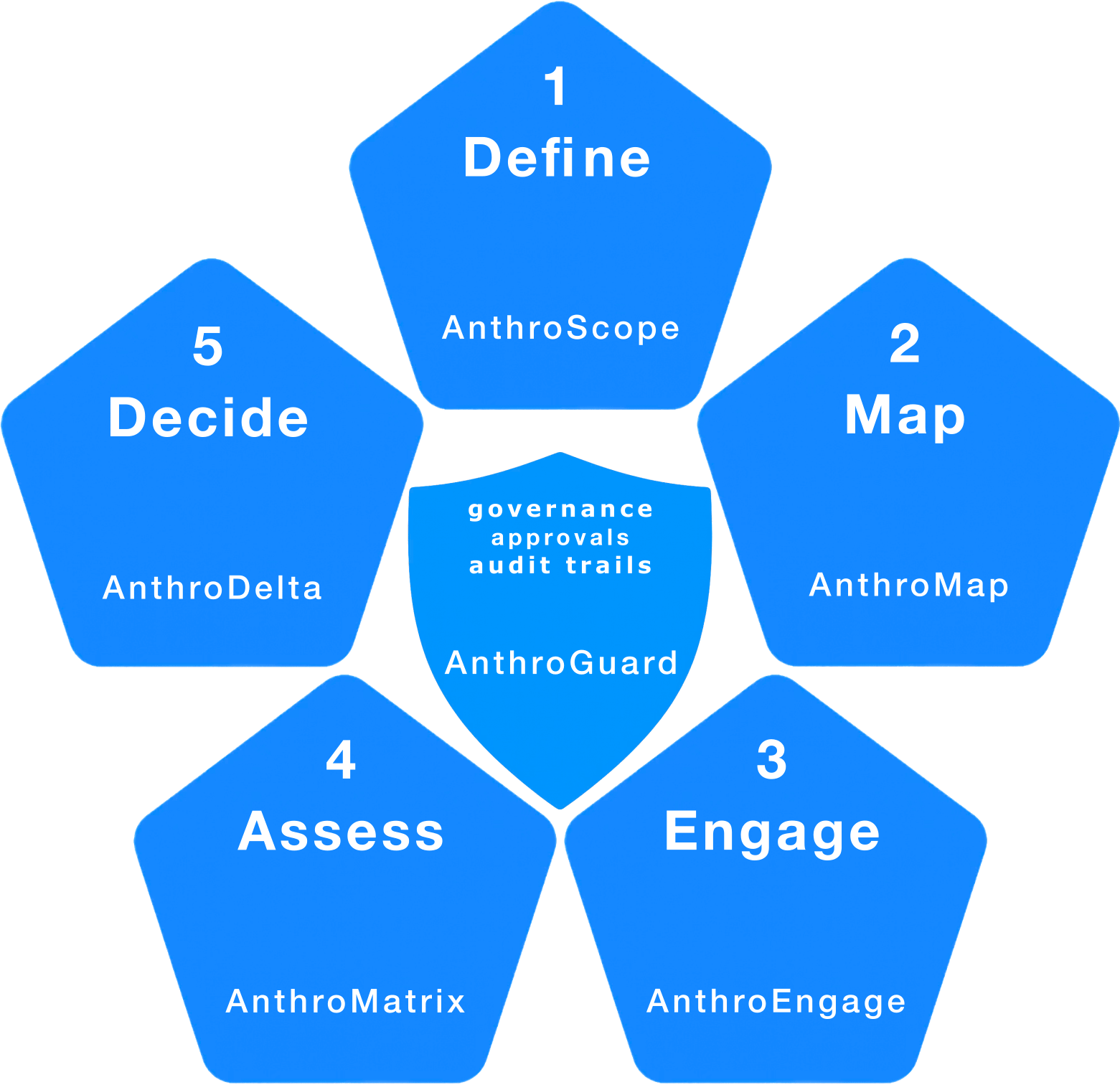
1 Clarify and calibrate the role, manage alignment:
assess workflow, define success profile, scorecard, non-negotiables and decision rights, build the role story, manage stakeholder alignment
2 Build the first Market Map Plus:
target universe, initial benchmark and pre-evaluated external options.
3 Test engagement reality early:
interest, timing, constraints and availability enter the decision logic.
Note: AnthroMethod includes candidate-winning and closing – starting at first outreach. Top candidates are still won in human moments: the role story, the first conversation, the quality of follow-up, the handling of confidentiality, and the close.
4 Build deeper evidence:
structured, role-specific evaluations, assessment and evidence updates.
5 Decide and close with control:
references, optional added assessment, stakeholder alignment, decision memo and closing.
Market Map Plus is a dynamic decision architecture.
Core Structure of Market Map Plus
Decision architecture:
- Built on a calibrated success profile
- Supported by a weighted scorecard
Dynamic by design:
- Versioned as evidence grows (typically v1–v3)
- v1 captures signals and initial fit
- v2 adds deeper assessment and engagement reality
- v3 adds references and other high-value evidence to support the final decision memo
Classic market map
- generic
- static
- name-list heavy
- difficult to audit
Market Map Plus
- mandate-bound
- benchmarked
- versioned
- engagement-aware
- controllable
- auditable
What AI accelerates — and what remains human
AI
AI accelerates research, signal aggregation, consistency checks, progress reporting and drafting of structured artifacts.
Human
Humans remain responsible for calibrating criteria, judging leadership behavior, running critical conversations, testing references, weighing trade-offs, making recommendations and closing.
Guard
AnthroGuard is the governance layer: data boundaries, access rules, approval gates, fairness safeguards, documentation and audit trail.
The artifacts serious buyers want to see
Human–AI
– split of work
Market Map Plus
– versions
Evidence
– pack per finalist
Choose the right entry point
A: Critical Role Decision Review
— when the next move is not yet clear.
B: Market Map Plus Sprint
— when you want external market visibility and
a decision checkpoint before committing.
C: Full mandate
— when the answer is already a confidential,
board-visible or transformation-critical search.
Note:
For selected clients, AnthroMethod can also extend into role and work design, succession radar and decision-quality enablement.
For selected full mandates, role and work design runs in parallel to market visibility and evidence-building.
For confidential discussions
for example:
- Critical Role Decision Reviews
- Critical roles in AI-shaped operating models
- Immediate priorities
For buyers who want to see the logic before they commit.